
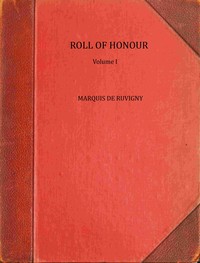
The Roll of Honour, Volume 1 : A biographical record of all members of His…
Let's be clear from the start: this is not a book you read from cover to cover. Compiled by the Marquis de Ruvigny in the years following World War I, The Roll of Honour is exactly what its title promises. It's a biographical register, a solemn list. It contains entries for thousands of British Army officers who lost their lives. Each entry is a small snapshot: name, rank, regiment, parentage, education, a line or two about their service, and the date and place of their death. There are no grand narratives here, just cold, hard facts laid out in dense columns.
Why You Should Read It
The power of this book isn't in a story it tells, but in the story it implies. Reading a history book gives you the broad strokes—the battles, the politics, the numbers. This book gives you the fragments. You see a lieutenant, age 19, who left Cambridge to enlist and died at Ypres. You see a captain, a noted athlete, killed in Gallipoli. The cumulative effect is staggering. It transforms the abstract 'war dead' into a relentless parade of individual futures cut short. It's an incredibly sobering experience. You don't analyze themes here; you feel the weight of collective loss. It’s a book that demands you slow down and pay attention to each name, reminding you that history is made of people, not just events.
Final Verdict
This is a niche book, but a profoundly important one. It's perfect for history buffs, genealogists, or anyone wanting to connect personally with the human cost of WWI. It's an essential reference for researchers and a powerful tool for teachers aiming to make history tangible. For the casual reader, I'd recommend dipping into it rather than trying to 'tackle' it. Keep it on a shelf, pull it out now and then, and spend ten minutes meeting a few of the people in its pages. It's not an easy or entertaining read, but it is a deeply moving and respectful one. Think of it less as a book and more as a preserved piece of collective memory.
Deborah Ramirez
1 year agoAmazing book.
Anthony Torres
1 year agoFast paced, good book.
Donna Rodriguez
6 months agoThe layout is very easy on the eyes.
Emma Johnson
3 months agoI have to admit, the character development leaves a lasting impact. Definitely a 5-star read.






Kenneth Wright
1 year agoHelped me clear up some confusion on the topic.