S
Sebastian Waack
Guest
- Thread Author
- #1
Collective Teacher Efficacy is the collective belief of teachers in their ability to positively affect students. With an effect size of d=1.57 Collective Teacher Efficacy is strongly correlated with student achievement. Here is a quick overview of John Hattie’s “new number one” influence.
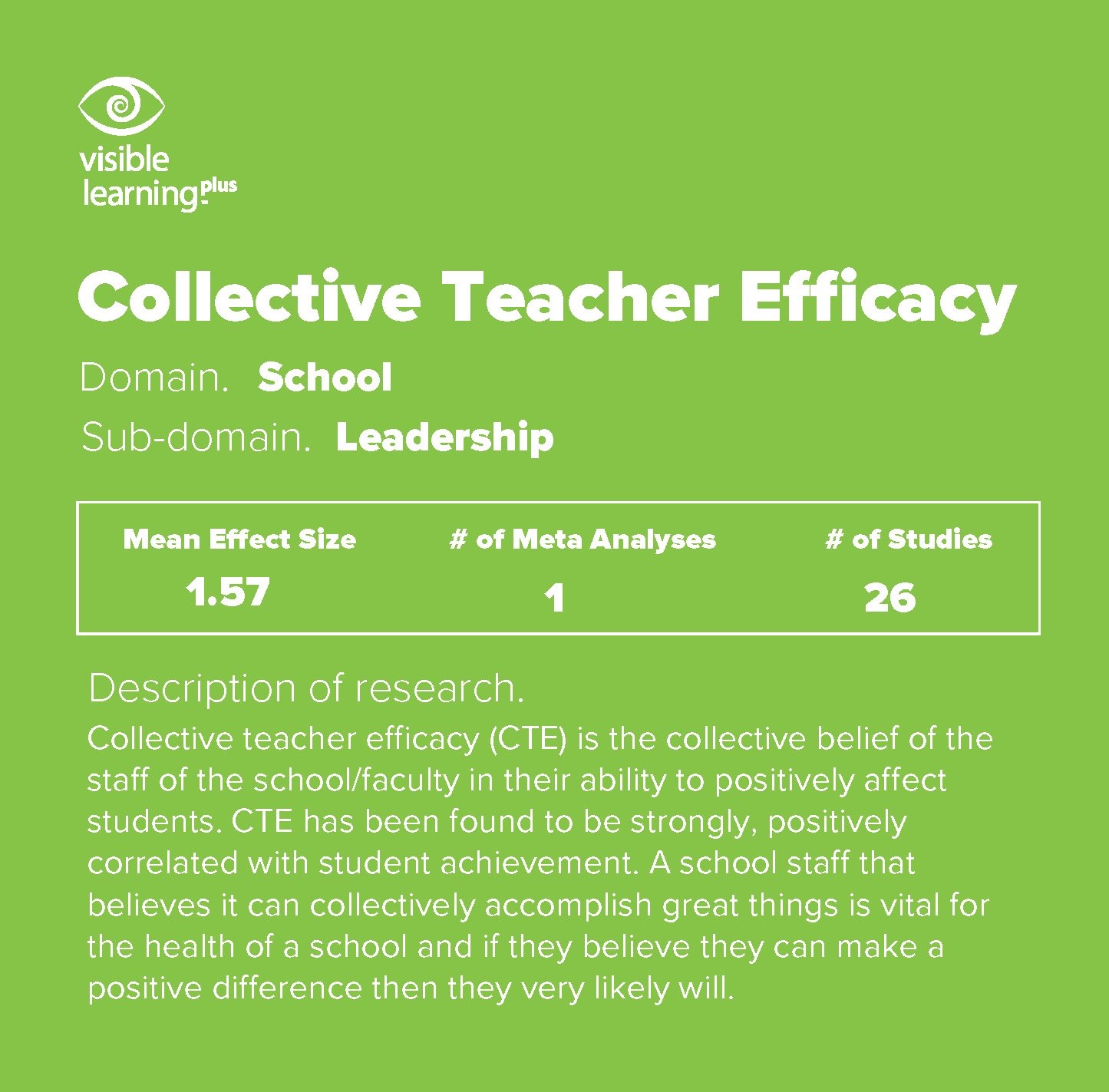
Image (c) Visible Learning Plus – www.visiblelearningplus.com
John Hattie and his team have presented Collective Teacher Efficacy (CTE) as the “new number one” influence related to student achievement several times, e.g. at the Annual Visible Learning Conference (2016) or the Collaborative Impact Conference 2017. Although Hattie’s latest published list of 195 effects in The Applicability of Visible Learning to Higher Education (2015) puts CTE only in second place, its effect size of d=1.57 is still huge: it is more than two times bigger than that of feedback (d=0.72), and almost three times bigger than the effect of classroom management (d=0.52). The message seems to be clear: together teachers can achieve more, especially if they collectively believe that they can do so!
Hattie’s new factor is based on Rachel Jean Eells’ “Meta-Analysis of the Relationship Between Collective Teacher Efficacy and Student Achievement” (PDF). For her Ph.D. thesis at the Loyola University Chicago, she has conducted a meta-analysis of 26 studies on Collective Teacher Efficacy and found that “the weighted average effect size of r-mean (outlier removed) was 0.617″. This number can easily be converted into Cohen’s d=1.568, the number Hattie reports.
The concept of Collective Teacher Efficacy itself is much older. It was introduced in the 1990s by Albert Bandura and is rooted in his concept of self-efficacy, Bandura (1993, 1997). He defines collective efficacy as “a group’s shared belief in the conjoint capabilities to organize and execute the courses of action required to produce given levels of attainment.” Bandura found that the positive effects of CTE on student academic performance more than outweigh the negative effects of low socioeconomic status.
His findings were later confirmed by Goddard, Hoy, and Hoy (2000). In their studies, they could demonstrate that between-school differences of collective teacher efficacy were more important in explaining student achievement than socioeconomic status. Moreover, Hoy, Sweetland, and Smith (2002) found that the strength of CTE helps the positive effects of individual teacher efficacy and vice versa. A stronger collective teacher efficacy seems to encourage individual teachers to make a more effective use of the skills they already have.
According to Hattie’s presentation at the Collaborative Impact Conference 2017 “Collective Teacher Efficacy” is not about making teachers feel good about themselves. It is more complicated than just believing you can make a difference collectively. One of the authors that come closest to Hattie’s definition “collaborative conversation based on evidence” is Jenni Donohoo with her book “Collective Efficacy: How Educators’ Beliefs Impact Student Learning“.
For further reading and a practical guide about how to build Collective Teacher Efficacy in your school, you should read the short and excellent Issue Brief “Building Collective Efficacy” by Dana Brinson and Lucy Steiner.
In recent a video John Hattie explains what Collective Teacher Efficacy is, and what it isn’t. Have a look.


 Read the books. Order your copy on Amazon or find them in a library.
The post Collective Teacher Efficacy (CTE) according to John Hattie appeared first on VISIBLE LEARNING.
Image (c) Visible Learning Plus – www.visiblelearningplus.com
John Hattie and his team have presented Collective Teacher Efficacy (CTE) as the “new number one” influence related to student achievement several times, e.g. at the Annual Visible Learning Conference (2016) or the Collaborative Impact Conference 2017. Although Hattie’s latest published list of 195 effects in The Applicability of Visible Learning to Higher Education (2015) puts CTE only in second place, its effect size of d=1.57 is still huge: it is more than two times bigger than that of feedback (d=0.72), and almost three times bigger than the effect of classroom management (d=0.52). The message seems to be clear: together teachers can achieve more, especially if they collectively believe that they can do so!
Hattie’s new factor is based on Rachel Jean Eells’ “Meta-Analysis of the Relationship Between Collective Teacher Efficacy and Student Achievement” (PDF). For her Ph.D. thesis at the Loyola University Chicago, she has conducted a meta-analysis of 26 studies on Collective Teacher Efficacy and found that “the weighted average effect size of r-mean (outlier removed) was 0.617″. This number can easily be converted into Cohen’s d=1.568, the number Hattie reports.
The concept of Collective Teacher Efficacy itself is much older. It was introduced in the 1990s by Albert Bandura and is rooted in his concept of self-efficacy, Bandura (1993, 1997). He defines collective efficacy as “a group’s shared belief in the conjoint capabilities to organize and execute the courses of action required to produce given levels of attainment.” Bandura found that the positive effects of CTE on student academic performance more than outweigh the negative effects of low socioeconomic status.
His findings were later confirmed by Goddard, Hoy, and Hoy (2000). In their studies, they could demonstrate that between-school differences of collective teacher efficacy were more important in explaining student achievement than socioeconomic status. Moreover, Hoy, Sweetland, and Smith (2002) found that the strength of CTE helps the positive effects of individual teacher efficacy and vice versa. A stronger collective teacher efficacy seems to encourage individual teachers to make a more effective use of the skills they already have.
According to Hattie’s presentation at the Collaborative Impact Conference 2017 “Collective Teacher Efficacy” is not about making teachers feel good about themselves. It is more complicated than just believing you can make a difference collectively. One of the authors that come closest to Hattie’s definition “collaborative conversation based on evidence” is Jenni Donohoo with her book “Collective Efficacy: How Educators’ Beliefs Impact Student Learning“.
For further reading and a practical guide about how to build Collective Teacher Efficacy in your school, you should read the short and excellent Issue Brief “Building Collective Efficacy” by Dana Brinson and Lucy Steiner.
Update
In recent a video John Hattie explains what Collective Teacher Efficacy is, and what it isn’t. Have a look.
Read the books. Order your copy on Amazon or find them in a library.References:
- BANDURA, A. (1993). Perceived self-efficacy in cognitive development and functioning. Educational Psychologist, 28 (2), 117–148. (Abstract)
- BANDURA, A. (1997). Self-efficacy: The exercise of control. New York, NY, US: W H Freeman. (Book)
- BRINSON & STEINER (2007): Building Collective Efficacy: How Leaders Inspire Teachers to Achieve. Issue Brief. The Center for Comprehensive School Reform and Improvement. (PDF)
- EELLS, R. J. (2011): Meta-Analysis of the Relationship Between Collective Teacher Efficacy and Student Achievement, (Abstract / Full text)
- GODDARD, HOY, WOOLFOLK HOY (2000): Collective Teacher Efficacy: Its Meaning, Measure, and Impact on Student Achievement. In: American Educational Research Journal Vol 37, Issue 2, pp. 479 – 507 (Abstract)
- HATTIE, J. (2015): The Applicability of Visible Learning to Higher Education. In: Scholarship of Teaching and Learning in Psychology, 1 (1), 79-91. (Abstract)
- HATTIE, J. (2016). Third Visible Learning Annual Conference: Mindframes and Maximizers, Washington, DC, July 11, 2016. (Programme)
- HOY, SWEETLAND, SMITH (2002). Toward an organizational model of achievement in high schools: The significance of collective efficacy. Educational Administration Quarterly, 38 (1), 77–93. (Abstract)
The post Collective Teacher Efficacy (CTE) according to John Hattie appeared first on VISIBLE LEARNING.